
Chemical Engineering combines the study of physical phenomena, chemical transformations, and process control to understand and develop technologies used across numerous industrial sectors. Teaching this discipline requires complementing theoretical knowledge with hands-on experiences that allow students to observe process behavior, analyze operating variables, and interpret experimental results.
For this reason, designing a Chemical Engineering laboratory requires a structured educational approach, in which equipment is selected according to the skills and competencies students are expected to develop. From studying unit operations to experimenting with chemical reactors, control systems, and pilot plants, each installation can contribute to a progressive learning experience connected to real-world industrial applications.
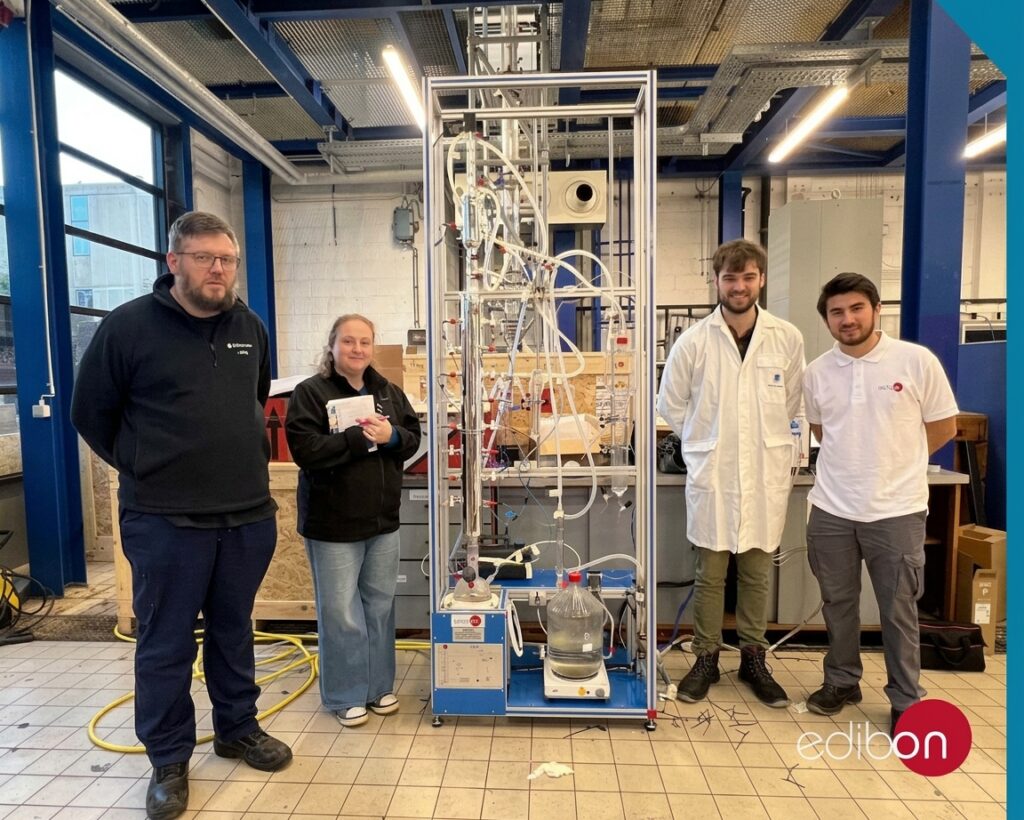
Unit Operations: Understanding the Fundamentals of Industrial Processes
Unit operations are a fundamental part of Chemical Engineering, as they provide a basis for studying the physical phenomena involved in numerous industrial processes. Distillation, extraction, absorption, and fluidization are examples of operations used to separate components, promote mass transfer, or analyze the behavior of fluids and particles.
Studying these operations experimentally allows students to connect theoretical principles with the operation of actual equipment, understand how operating conditions influence process behavior, and develop skills in data analysis and interpretation.
To explore these concepts, EDIBON offers a range of specialized units.
The Computer Controlled Continuous Distillation Unit (UDCC) allows students to study the separation of components in a liquid mixture through distillation. Students can observe how the column operates and analyze the influence of operating conditions on the separation process.
The Computer Controlled Fixed and Fluidized Bed Unit (LFFC) enables students to investigate the behavior of a particle bed as a fluid flows through it, examining the differences between fixed and fluidized bed conditions and how the system responds to changes in operating conditions.
Similarly, the Computer Controlled Liquid-Liquid Extraction Unit (UELLC) allows students to study the transfer of a component between two liquid phases and understand the principles that influence extraction efficiency.
Another important operation is gas absorption, which can be studied using the Computer Controlled Gas Absorption Column (CAGC). This unit allows students to analyze mass transfer between a gas stream and a liquid phase, expanding their experimental understanding of separation operations.
Combining different unit operation experiments provides students with opportunities to investigate complementary phenomena and establish a foundation for more advanced Chemical Engineering studies.
Chemical Reaction Engineering: Analyzing Chemical Transformations
In addition to physical separation and transfer operations, Chemical Engineering education requires an understanding of processes in which substances are transformed into other substances through chemical reactions.
Studying chemical reactors allows students to analyze how reactor configuration and operating conditions influence reaction behavior. It also enables them to compare different approaches to carrying out chemical transformations and understand the importance of selecting an appropriate reactor configuration for a given process.
To explore these concepts, EDIBON offers the Computer Controlled Chemical Reactors (QRC), which allow students to experiment with different reactor configurations, including continuous stirred-tank reactors, tubular reactors, batch reactors, and stirred-tank reactors connected in series.
By comparing these configurations, students can investigate reactor behavior and analyze how operating conditions influence chemical reactions.
In this way, experimental training encompasses not only the study of physical phenomena but also the analysis of chemical transformations involved in industrial processes.
Data Acquisition, Instrumentation, and Control: Understanding Process Behavior
Experimental work in Chemical Engineering involves more than simply observing how equipment operates. It also requires collecting process information, analyzing how operating variables change, and understanding the relationship between operating conditions and experimental results.
Data acquisition, monitoring, and control therefore play a role throughout experimental education, from the study of individual unit operations to more complex systems.
In this area, EDIBON’s SCADA System enables real-time process monitoring, data acquisition and visualization, alarm management, and the use of control functions and customizable calculations.
These tools allow students to track changes in operating variables, interpret information collected during experiments, and understand how digital systems are used to monitor and control processes.
Integrating data acquisition and control tools helps connect academic experimentation with monitoring and control methods used in industrial environments.
Digitalization is therefore not necessarily a separate or subsequent stage of learning. Instead, it can be incorporated at different educational levels, depending on the capabilities of each unit and the learning objectives.
Pilot Plants: Connecting Experimental Learning with Industrial Processes
After studying the fundamentals of unit operations and chemical transformations, pilot plants allow students to expand the scope of their experimental work by using larger-scale installations.
These installations play an important role in Chemical Engineering education because they provide opportunities to investigate processes using configurations and operating conditions related to industrial applications.
While laboratory units may focus on individual phenomena and specific operations, pilot plants provide opportunities to work with larger installations, investigate a broader range of operating conditions, and connect previously acquired knowledge with industrial processes.
EDIBON offers different pilot plants designed for experimental work in this field.
The Computer Controlled and Touch Screen Solid-Liquid Extraction Pilot Plant (SLE00) allows students to study the extraction of soluble components from a solid using a solvent.
The Computer Controlled and Touch Screen 4 l/h Corrosive Solvent Recovery Distillation Pilot Plant (CSRD/4/CTS) is designed to study the recovery of corrosive solvents through distillation.
Both installations allow students to explore separation operations that can also be studied at the laboratory scale, providing opportunities to investigate their behavior in larger-scale systems.
Incorporating pilot plants expands experimental learning opportunities and brings students closer to analyzing processes under conditions more representative of certain industrial applications.
How to Select Equipment for a Chemical Engineering Laboratory
Not every Chemical Engineering laboratory requires the same equipment or installations. Its configuration should reflect the institution’s educational objectives, areas of specialization, academic levels, and the practical knowledge and competencies students are expected to develop.
Before selecting equipment, it is therefore important to identify which phenomena, operations, and processes students need to investigate experimentally.
A laboratory focused on foundational education may prioritize unit operation equipment that allows students to study individual phenomena and analyze their operating variables.
Programs covering more advanced topics may incorporate chemical reactor systems and equipment that provides additional opportunities for data acquisition, monitoring, and control.
Institutions seeking to connect experimental education with specific industrial applications may also incorporate pilot plants that allow students to investigate operations on a larger scale.
These possibilities do not represent a mandatory sequence or a single laboratory configuration. The key is to select equipment according to a coherent educational strategy, ensuring that different experimental activities complement one another and contribute to the intended learning outcomes.
Chemical Engineering Laboratories Tailored to Each Institution
The diversity of academic programs and areas of specialization means that laboratory design requires solutions tailored to the needs of each institution.
EDIBON offers equipment for studying unit operations, chemical reactors, data acquisition and control systems, and pilot plants, among other solutions for education and experimental research.
In addition to its standard equipment catalog, EDIBON’s in-house design and manufacturing capabilities allow the company to develop special-purpose equipment and customized configurations to meet specific educational and technical requirements.
This makes it possible to plan laboratories with different levels of complexity and select installations that align with each institution’s objectives.
A well-designed Chemical Engineering laboratory is defined not simply by the number of units it contains, but by its ability to provide complementary experimental experiences that support the development of students’ knowledge and skills.
From studying fundamental phenomena to experimenting with pilot plants and industrial control technologies, the goal is to create learning environments that help students understand chemical processes, analyze their behavior, and establish meaningful connections between academic education and industrial applications.
At EDIBON, we develop solutions to support universities and educational institutions in designing and equipping their Chemical Engineering laboratories, adapting to their educational, technical, and experimental requirements.

About EDIBON
EDIBON is a global leader in technical education and research equipment, driving innovation in training and scientific advancement since 1978.
We specialize in the design and manufacture of advanced educational equipment and pilot plants across 14 key areas of engineering and science.
With more than 4,500 solutions developed in-house, we combine cutting-edge technology and innovative approaches to support hands-on learning, experimentation, and process optimization.
Our commitment to quality and precision enables us to provide comprehensive service — from design and production to installation, training, and support — ensuring success and satisfaction for educational institutions, research centers, and industry professionals worldwide.
Article submitted by:
EDIBON International, S.A
Spain