Modern industrial technology relies on the interaction of many disciplines. Mechanics, electrical engineering, pneumatics, sensors and software work together, shaping a wide range of technical professions. The competencies learners need therefore vary depending on their chosen field.
In metalworking, the focus is on manufacturing and assembly. Industrial mechanics adds pneumatics and control engineering, while mechatronics combines mechanical systems with sensors, electronics, programming and connectivity. This raises an important question for technical education and training: How can these different competency profiles be developed through practical learning with a clear connection to real-world applications?
The Lucas-Nuelle slewing crane training concept addresses this question through three independent training projects. All three share the same technical application but focus on different disciplines. They offer three pathways to practical technical competence, tailored to the respective field, learning objectives and learners’ existing knowledge.
Competence develops through practical application
Technical competencies become easier to understand when individual tasks form part of a recognisable overall process. Technical drawings, manufacturing tasks, pneumatic circuits and programming code all serve a specific purpose within a project.
With the slewing crane, this purpose leads to a visible result: something moves. Learners can see directly how their work contributes to the operation of the system as a whole.
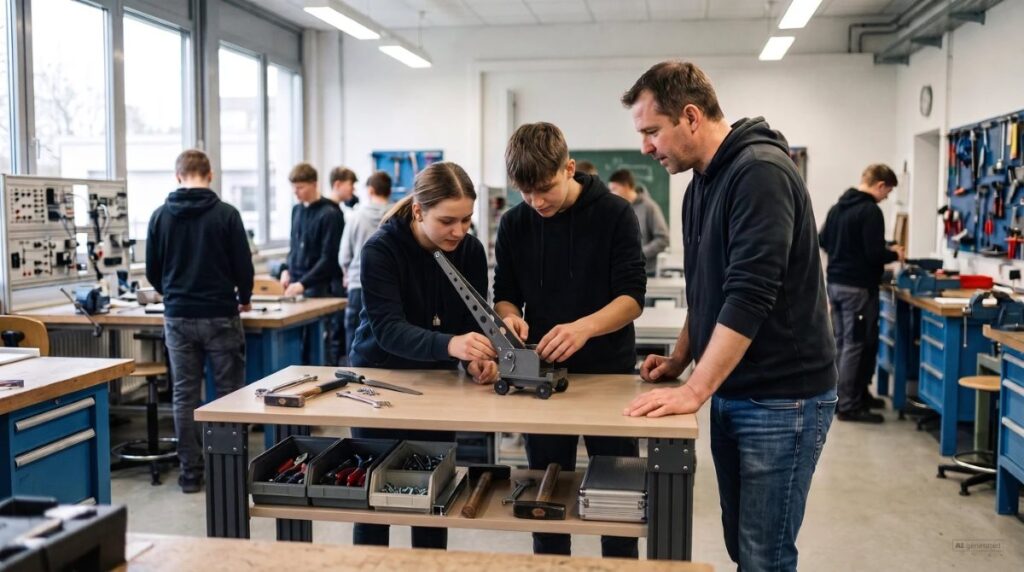
Metalworking: understanding how things are made
Slewing Crane Model 1 focuses on fundamental metalworking skills. Learners read technical drawings, plan work steps and process materials. They practise filing, drilling, tapping threads, bending components and producing turned parts. They then assemble the components and check dimensions and quality.
Each manufacturing task serves a clear purpose. Step by step, individual workpieces become part of a functional project. Learners see how precision and workmanship affect subsequent assembly and the operation of the finished system.
Pneumatics and control engineering: making connections visible through movement
Slewing Crane Model 2 focuses on industrial mechanics, pneumatics and control engineering. Learners assemble components such as linear guides and gantry axes, connect pneumatic components using tubing, and work with electrical circuit diagrams and pneumatic schematics.
The pneumatic clamshell gripper and control system make the function of individual components immediately visible. Troubleshooting also becomes an important part of the learning process. Incorrect movement may have mechanical, pneumatic or electrical causes. Learners must understand how the components interact, narrow down possible causes and systematically test their assumptions. This helps them develop an understanding of how mechanics and control engineering work together within a technical application.
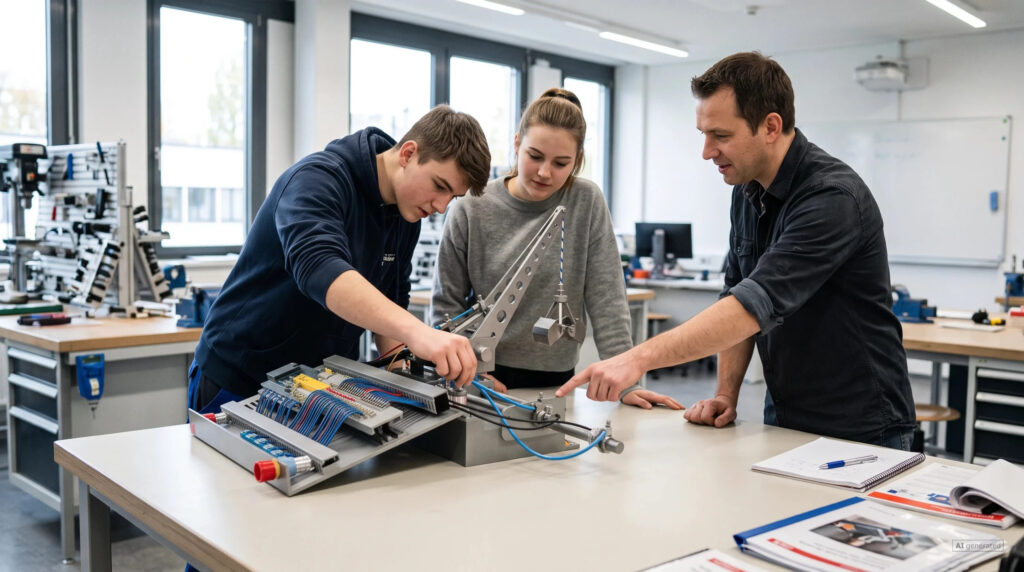
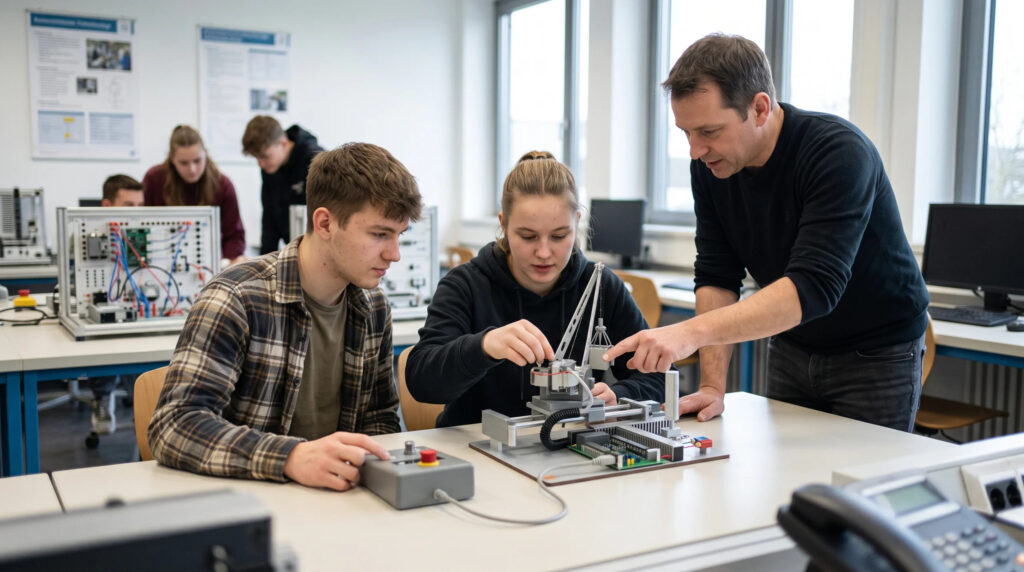
Mechatronics and automation: experiencing connected technology in practice
Slewing Crane Model 3 focuses on mechatronics and automation. Electronic control, sensors, motor drives and software interact within a single application. Learners work with a motorised four-axis kinematic system and an ESP32 controller. They program sequences, configure drives, calibrate sensors and commission system functions. IoT and web applications also provide practical experience of modern connected technologies.
Troubleshooting requires learners to consider information from mechanics, electronics and software together. This helps them understand how automated functions interact within a complete mechatronic system.
One crane – three independent projects
Each of the three slewing crane projects focuses on a different technical discipline. Educational institutions can therefore select the project that best suits their training programmes, learning objectives and learners’ existing knowledge.
What connects them is the shared application. Whether the focus is metalworking, pneumatics or automation, individual tasks lead to a visible technical result. Each project follows the same fundamental principle: understand, apply, set in motion and gain insight.
Learners first explore the task and the intended outcome. They then put their specialist knowledge into practice. The crane’s movement makes functions and technical relationships visible. Once the project is complete, they can see how their work contributes to a functioning system.
This approach is particularly relevant in an international context. Curricula, vocational qualifications and technical standards vary from country to country, as do the areas of technical specialisation. A tangible application can help make learning objectives across different technical disciplines easier to understand and achieve.
Complexity becomes manageable when it becomes tangible
Technical competence develops when knowledge has a clear practical purpose. A component becomes part of a crane, a pneumatic circuit triggers movement, and programming code controls a real mechanical application. The three slewing crane projects provide different routes into technical learning – from fundamental metalworking skills through pneumatics and control engineering to mechatronics and automation.
In this way, specialist knowledge develops into practical competence and the ability to act independently.
About Lucas-Nülle GmbH
Lucas-Nuelle develops smart training solutions that combine theoretical knowledge with real-world practice, enabling learners to experience and understand complex concepts through hands-on engagement. Using tangible, industry-relevant systems, our approach ensures that learning is not only effective but memorable — because when people do things themselves and connect emotionally with the process, knowledge sticks. Our training systems integrate a user-friendly e-learning environment with real equipment and structured courses across key technologies such as mobility, building, energy and industry.
Article Submitted by
Dagmar Bona
Lucas-Nülle GmbH