Artificial Intelligence (AI) is transforming the way engineering systems are monitored, analyzed, and controlled. From identifying patterns in large datasets to recognizing objects through computer vision, AI technologies are becoming increasingly relevant across industrial processes, automation, and technical applications. For universities and engineering schools, this evolution raises an important educational challenge: how can students move beyond understanding AI concepts and gain practical experience developing and implementing intelligent applications?
An Applied Artificial Intelligence Laboratory address this challenge by connecting programming, data analysis, machine learning algorithms, and physical devices. Rather than studying these technologies independently, students should be able to understand how they interact throughout the development of an AI-based application, from data acquisition to decision-making and physical actuation.
Why do engineering students need practical AI training?
Understanding Artificial Intelligence requires more than learning how algorithms work. Students also need to understand the data on which these algorithms depend, the conditions under which models are trained, and the limitations that affect their performance.
Machine Learning (ML) enables computer systems to identify patterns and learn from data without requiring every decision rule to be explicitly programmed. Deep Learning (DL), a subset of Machine Learning based on artificial neural networks with multiple layers, can address more complex tasks, particularly in image recognition and other applications involving large or complex datasets.
However, developing a functional AI application involves several interconnected disciplines. Data acquisition, programming, database management, communication networks, image processing, and automation all contribute to the final result.
Practical training allows students to understand these relationships by working with real measurements, creating their own datasets, training models, evaluating their performance, and applying their outputs to specific tasks. This approach also helps develop essential engineering competencies, including analytical thinking, problem-solving, programming, and the interpretation of experimental results.
From data acquisition to intelligent decision-making
A fundamental aspect of any AI application is the quality and availability of its data. An algorithm can only provide meaningful results when it receives information that is relevant to the problem being addressed.
Data Acquisition and Dataset Preparation
The first step is obtaining information from the environment or process under study. Sensors can measure variables such as temperature, humidity, pressure, light intensity, electrical current, distance, and movement. These measurements can be transmitted to a computer or server, where they are stored and organized for subsequent analysis.
Students can work with this information to create datasets, explore variable relationships, identify inconsistencies, and prepare the data for model development. They can also compare real-time measurements with historical records to understand how operating conditions influence the information collected.
This stage provides an opportunity to study data processing, statistical analysis, visualization, and Extract, Transform, Load (ETL) workflows. It also introduces an important principle: datasets must be representative of the conditions in which a model is expected to operate.
Machine Learning and Deep Learning model development
Once the data has been prepared, students can begin developing Machine Learning models. Depending on the learning objective, they can explore supervised learning, using labeled examples, or unsupervised learning, which identifies patterns and structures in data without predefined labels.
Comparing different algorithms allows students to understand how model selection affects performance. They can also investigate the influence of training data, adjust model parameters, and study how different configurations affect prediction accuracy.
For more complex applications, Deep Learning introduces artificial neural networks capable of learning increasingly sophisticated patterns. Developing and training these models helps students understand their structure, computational requirements, and potential applications.
Model evaluation and inference
Training a model does not automatically mean that it will perform reliably with new information. Evaluation is therefore an essential part of the learning process.
Students can assess classification accuracy, analyze prediction errors, and interpret confusion matrices to identify correct and incorrect classifications. Comparing training and validation results also helps them recognize problems such as overfitting and understand the importance of testing models with data that has not been used during training.
Once validated, a model can be used to perform inference: processing new input data to generate a prediction, classification, or other output. This is the stage at which the model begins to provide information that can support a practical decision.
Computer vision and edge AI: Bringing Artificial Intelligence closer to real applications
Not all AI applications rely on numerical measurements. Computer vision enables systems to extract information from images and video, making it possible to identify objects, recognize visual characteristics, and classify different elements.
In an educational laboratory, a camera can be used to acquire images and create datasets containing objects with different colors, characteristics, or visible defects. Students can then develop image-processing techniques and train classification models to distinguish between different categories.
For example, identifying objects by color or differentiating between defective and non-defective pieces provides a practical introduction to visual inspection applications commonly associated with automated processes. These exercises also allow students to investigate how external conditions, particularly lighting, can influence image acquisition and classification performance.
Another relevant concept is Edge AI, which involves executing AI models on devices located close to where data is generated rather than relying exclusively on remote computing resources.
This approach is particularly interesting when applications require low latency, reduced data transmission, or local processing. By deploying and optimizing models for Edge Computing, students can investigate the relationship between computational resources, model complexity, processing time, and application requirements.
Connecting Artificial Intelligence with physical processes: IoT, sensors, and actuators
One of the most important steps in applied AI education is understanding how algorithmic results can interact with physical systems.
The Internet of Things (IoT) provides the communication infrastructure needed to connect sensors, computing devices, and servers. Through communication technologies and protocols such as MQTT and HTTP, information can be exchanged between different components, enabling data collection, remote monitoring, and interaction between systems.
Once a model generates an output, that information can be used as an input for a decision-making or control process. For example, an AI model can classify the operating state of a process or identify an abnormal pattern. The resulting information can then support an appropriate response through an actuator.
In practical training, students can explore these relationships using devices such as DC motors, servomotors, stepper motors, lighting elements, and thermoelectric modules. They can develop applications in which acquired variables influence actuator operation, or in which the output of a Machine Learning model contributes to a control decision.
It is important to distinguish between AI-based inference and control algorithms: a model can provide a prediction or classification, while a separate control strategy determines how the physical system should respond. Understanding this distinction is essential when developing reliable automation applications.
What should an applied Artificial Intelligence Laboratory include?
A well-designed laboratory should provide the resources needed to work through the different stages of an AI application while allowing students to understand how its components communicate.
The main elements to consider include:
- AI computing resources: A computer with suitable CPU, memory, storage, and GPU capabilities for developing, training, and executing Machine Learning and Deep Learning models.
- Data acquisition and control devices: Microcontrollers and interfaces for connecting sensors, collecting measurements, and operating actuators.
- Data storage and management: A server and database infrastructure for storing measurements, consulting historical information, and visualizing process variables.
- Computer vision equipment: A camera and suitable objects for image acquisition, dataset creation, and visual classification exercises.
- IoT communication infrastructure: Network devices and communication interfaces that allow information to circulate between sensors, computing resources, and servers.
- Development software: Programming environments and libraries for data analysis, Machine Learning, Deep Learning, image processing, and graphical representation.
These elements should be selected according to the laboratory’s educational objectives, the complexity of the experiments, and the number of students who will use the installation. Computational capacity, connectivity, software compatibility, and opportunities for future expansion are also important considerations.
Designing a laboratory around educational objectives
The design of an Applied Artificial Intelligence Laboratory should begin with the competencies students are expected to develop, rather than with a predefined list of hardware components.
A program focused on Machine Learning may prioritize data acquisition, dataset preparation, algorithm comparison, and model evaluation. A course addressing computer vision will require suitable image acquisition resources and opportunities to develop and test classification models. Meanwhile, programs connecting AI with automation should incorporate sensors, communication devices, and actuators to explore how model outputs can interact with physical processes.
These approaches are not mutually exclusive. An integrated laboratory can support different levels of complexity, allowing students to progress from individual exercises to applications combining several technologies.
It is also important to consider how data, software, and hardware will work together. A suitable architecture should facilitate communication between devices, provide access to acquired information, and allow models to be developed and executed under different operating conditions.
Building practical AI skills with EDIBON
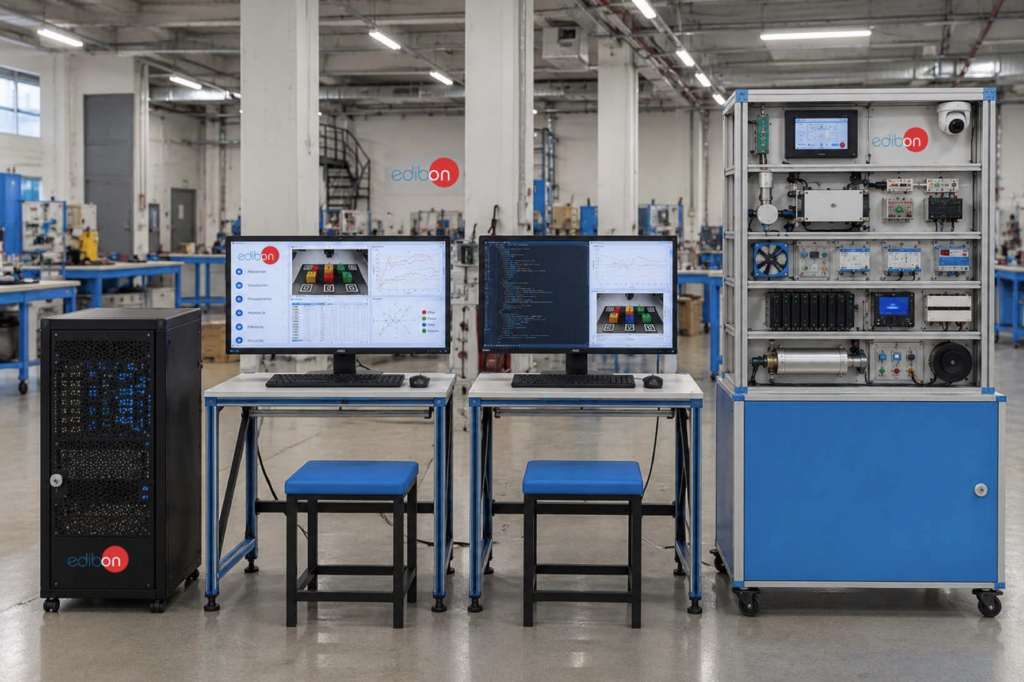
Designed by EDIBON, the Applied Artificial Intelligence Laboratory (AAIL) provides an integrated environment for studying the development and implementation of AI applications through experimental work.
The laboratory brings together AI computing resources, a data server, a camera, an acquisition and IoT control kit, sensors, actuators, and software tools. This configuration allows students to work through the complete application development cycle: data acquisition, storage, preparation, model training, evaluation, inference, decision-making, and physical actuation.
Its experimental possibilities include comparing Machine Learning algorithms, developing neural networks, analyzing classification errors, creating computer vision applications, implementing IoT communications, and using AI model outputs to interact with physical devices.
With more than 45 years of experience in the design, development, and manufacture of educational and technical training equipment in Spain, EDIBON supports universities and training centers in equipping laboratories according to their academic and technical requirements.
The AAIL reflects an educational approach in which Artificial Intelligence is not studied solely as a computational discipline, but as a technology that can be connected to data acquisition, communication networks, and physical engineering applications. This integration helps students develop a broader understanding of intelligent systems and prepares them to work with the technologies increasingly present in modern engineering environments.

About EDIBON
EDIBON is a global leader in technical education and research equipment, driving innovation in training and scientific advancement since 1978.
We specialize in the design and manufacture of advanced educational equipment and pilot plants across 14 key areas of engineering and science.
With more than 4,500 solutions developed in-house, we combine cutting-edge technology and innovative approaches to support hands-on learning, experimentation, and process optimization.
Our commitment to quality and precision enables us to provide comprehensive service — from design and production to installation, training, and support — ensuring success and satisfaction for educational institutions, research centers, and industry professionals worldwide.
Article submitted by:
EDIBON International, S.A
Spain