Technical education has, for decades, successfully focused on the structured delivery of specialist knowledge. Clear curricula, sequential content and defined learning objectives have played a key role in ensuring that qualifications are comparable and reliable.
However, under today’s conditions, the question increasingly arises as to whether this model alone is still sufficient.
The critical challenge between knowledge and application
In many education systems, practical elements are firmly embedded – in workshops, laboratories or within dual training programmes. Nevertheless, companies and educational institutions alike report a recurring observation: the transfer of knowledge into concrete real-world situations does not always run smoothly.
This does not mean that knowledge is lacking. Rather, it becomes clear that applying knowledge represents a distinct capability – one that must be deliberately developed. In everyday professional life, tasks are rarely clearly defined with unambiguous solutions. More often, skilled professionals face situations that require evaluation, prioritisation and independent decision-making.

Changing requirements in a complex working world
This development is further intensified by technological and societal change. Digital systems, automation and artificial intelligence are transforming not only work processes but also the role of skilled professionals.
Knowledge remains an important foundation – but its significance is evolving. What matters less is how much knowledge is permanently retained, and more how effectively and efficiently knowledge can be accessed, evaluated and applied.
Increasingly, the following capabilities are required:
- analysing complex situations
- identifying and synthesising relevant information in a targeted way
- weighing up possible courses of action
- making decisions under uncertainty
- taking responsibility for outcomes
As a result, the focus is shifting from the reproduction of knowledge to a broader competence in action – including the ability to acquire knowledge situationally and use it productively.
Rethinking learning: From knowledge acquisition to decision-making processes
As requirements evolve, so too must the structure of learning.
A forward-looking approach no longer views learning solely as the linear acquisition of knowledge, but as a process in which learners actively engage with problem scenarios.
At its core are questions such as:
- Which information is relevant in a given situation?
- Which solution paths are possible?
- Which decision is appropriate under the given conditions?
Learning thus becomes more context-driven and closely aligned with real-world demands. Knowledge does not emerge in isolation, but through the interplay of application and reflection..

Digital or hands-on? Both!
In the context of digitalisation, education is often framed as a tension between digital learning and practical training. This dichotomy is misleading.
Particularly in technical education, sustainable learning does not arise from choosing one over the other, but from the deliberate integration of both. Digital learning environments can provide orientation, visualise complex relationships and structure learning processes. However, real competence develops where learners take action – on real systems, with real components and under practical conditions.
The true added value therefore lies in the combination: digital support makes practical training more accessible, structured and transparent, while practical application gives digital learning meaning and depth.
Integrated learning environments as a key approach
To enable such learning processes, environments are required that systematically combine digital and practical elements.
In integrated learning environments:
- tasks are embedded in realistic contexts
- knowledge acquisition is situation-based
- decisions and their consequences become visible
- learning is immediately applied and reflected upon in practice
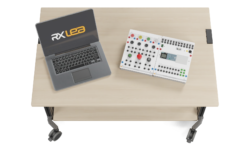
Digital learning worlds such as RXLea from Lucas-Nuelle follow this approach by structuring learning processes and linking them with practical applications – for example through training systems and real experiments.
This creates not a contrast between digital learning and practical training, but a continuous learning environment in which both elements are seamlessly integrated.
New roles in the learning process
This development also changes the roles of those involved. Learners take on a more active role and shape their learning process more independently. They analyse situations, make decisions and apply these in concrete scenarios.
Educators, in turn, guide these processes, provide orientation and offer targeted support where needed. Digital tools can help to make learning progress transparent and support individual development.
Implications for education systems
This shift affects not only individual teaching methods, but the fundamental orientation of education.
Key questions include:
- How can learning processes be more closely aligned with real-world action scenarios?
- How can the connection between digital learning and practical application be systematically designed?
- How can decision-making skills be deliberately fostered?
These questions are crucial for the future viability of education systems worldwide.
Conclusion
Technical education is not faced with the task of fundamentally replacing existing structures. Rather, the aim is to develop them further in a targeted way. Knowledge remains an essential foundation. However, it is only through application – through the interaction of digital support and real practice – that it unfolds its full value.
The key question is therefore no longer only what learners know, but whether they are able to apply this knowledge effectively in real situations. Technical education that focuses on this creates the foundation for skilled professionals who not only understand, but are able to act.
To find out how the learning world RXLea is rethinking education, click here.
About Lucas-Nülle GmbH
Lucas-Nuelle develops smart training solutions that combine theoretical knowledge with real-world practice, enabling learners to experience and understand complex concepts through hands-on engagement. Using tangible, industry-relevant systems, our approach ensures that learning is not only effective but memorable — because when people do things themselves and connect emotionally with the process, knowledge sticks. Our training systems integrate a user-friendly e-learning environment with real equipment and structured courses across key technologies such as mobility, building, energy and industry.
Article Submitted by
Dagmar Bona
Lucas-Nülle GmbH