As electrification fundamentally transforms automotive technology and electric and hybrid vehicles become a standard part of everyday work in workshops and service centres, the demands placed on skilled professionals are also increasing. Anyone working on high-voltage systems must understand technical relationships, master defined safety procedures and reliably assess system states. This is precisely where it becomes clear that safety goes far beyond knowing the regulations. What matters is whether professionals can apply this knowledge reliably in real working situations.
When safety knowledge must translate into safe action
Clear rules and defined procedures provide the foundation for working with high-voltage systems. Learners need to know when a system must be de-energized, which steps are required and how to verify the absence of voltage afterwards. In practice, these tasks are closely interconnected. Professionals must identify the current system state, select an appropriate isolation procedure, use measuring instruments correctly and evaluate the results from a technical perspective. Safe working practices therefore result from a sequence of correct actions and decisions. Theoretical knowledge only becomes practical safety competence when learners carry out the procedures themselves and understand the effects of their actions.
Why safe procedures require repetition
Understanding a procedure is an essential first step. Confidence in carrying it out, however, develops through practical application. By performing an isolation procedure several times, learners increasingly understand how the individual steps interact. Which components determine the system state? Where can a high-voltage system be isolated? Which measurement confirms that the required state has been reached? And how can learners recognize when the system behaves differently than expected?
Repetition helps future professionals review their own approach and make increasingly reliable decisions. The learning process follows a clear sequence: understand, perform, measure, evaluate and apply again. This raises a key question for technical education: How can safety-critical procedures be trained in a way that gives learners sufficient practical experience before they work on a real vehicle?
A safe learning environment before working on real vehicles
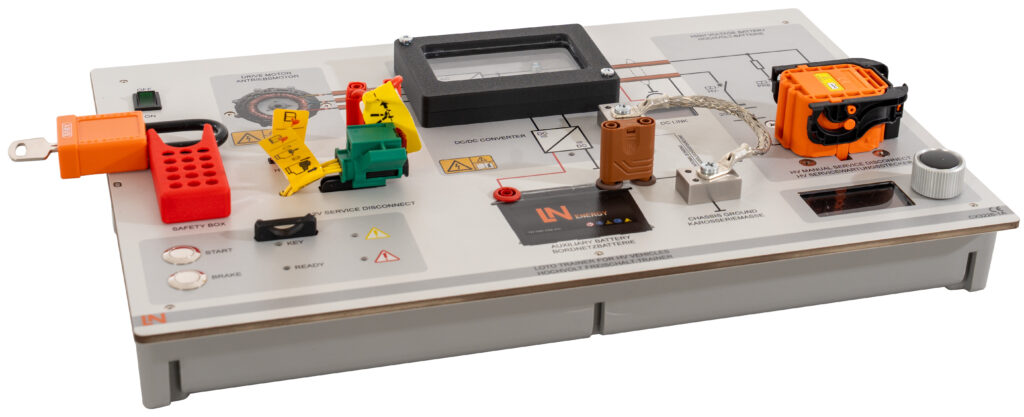
Systematic competence development requires learning environments in which individual procedures can be repeated safely and technical relationships can be explored in a targeted way. The Lucas-Nuelle LOTO-Trainer (Lockout/Tagout) provides a compact training environment for practising key procedures within a high-voltage system. Learners explore the interaction between the high-voltage battery, power electronics, low-voltage isolation points and other relevant components. Different common isolation procedures can be carried out in practice, allowing learners to directly observe their effects. These include both direct and indirect procedures involving the high-voltage and low-voltage systems.
This creates a protected training environment in which learners can repeat and consolidate their actions until they develop reliable routines. They can then transfer the knowledge and experience they have gained to real vehicles.
Safety does not end with isolation
Isolating the system is a key step. Afterwards, professionals must reliably determine whether the system has actually reached the expected state. Measurement technology is therefore an integral part of safety competence. Learners need to select the appropriate measuring instruments, use them correctly, identify suitable measuring points and evaluate the measured values.
The LOTO-Trainer enables learners to verify the absence of voltage and check insulation and equipotential bonding, among other tasks. Practice-oriented measuring points allow them to investigate real resistance values and system states directly. This connects practical action with technical understanding. Learners perform a work step, measure its result and assess the state of the system. In this way, they understand why specific checks are necessary and what a measured value means for the next step in the process.
What happens when the system behaves differently than expected?
In everyday professional practice, technical systems do not always behave as expected. Training should therefore also give learners experience with deviations and faults. The LOTO-Trainer allows up to ten faults based on real workshop scenarios to be introduced deliberately. Learners analyse the resulting system states, take measurements and systematically narrow down possible causes. This changes the nature of the learning task. Learners are no longer simply repeating a familiar procedure. They must observe the system, interpret measurement results and decide how to proceed.
These situations are particularly valuable for developing a deeper understanding of the system. Learners who can recognize and evaluate different system states are better prepared to act systematically and safely in real working situations. They also learn to recognize the limits of their own qualifications and act accordingly.
From training procedures to practical competence
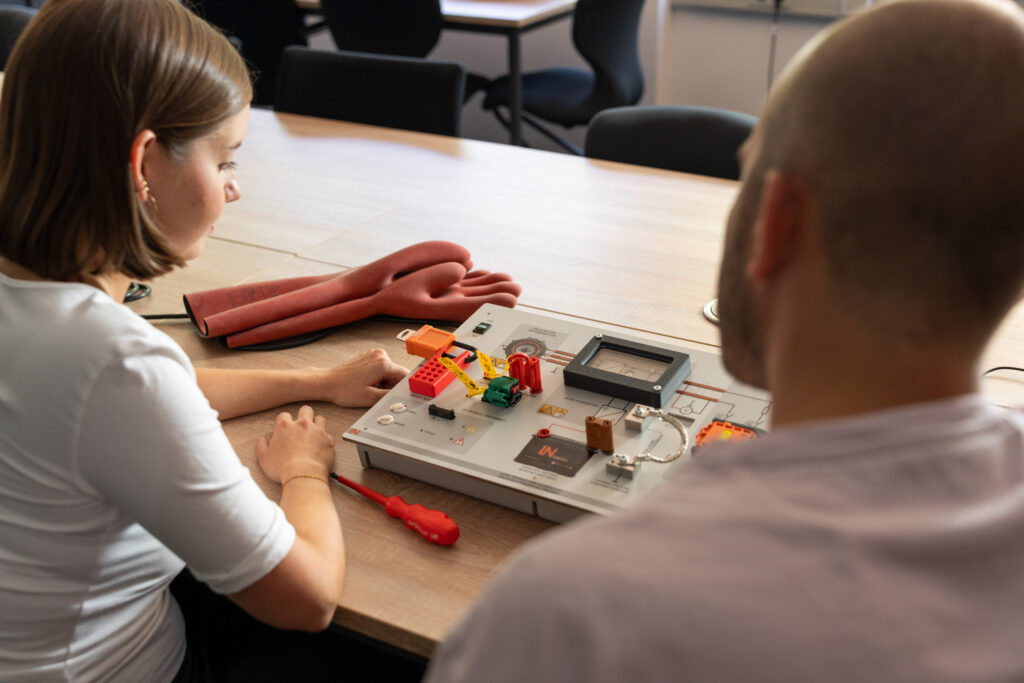
The goal of high-voltage qualification is the safe transfer of knowledge and skills to real working situations. To achieve this, learners need both a sound understanding of technical relationships and sufficient practical experience. The learning process therefore progresses from understanding the system architecture to isolation procedures and measurement technology, and finally to diagnosing typical faults.
This approach reflects the principle of Real Experience Learning. Learners work with real hardware, perform technical tasks themselves and directly experience the effects of their decisions. Technical knowledge, practical experience and reflection are closely interconnected.
Conclusion: Safety develops through established routines
As electrification continues to advance, high-voltage qualification is becoming increasingly important. Safety regulations and technical fundamentals provide the necessary foundation. In professional practice, however, what matters is whether future skilled professionals can apply this knowledge safely. They need opportunities to perform isolation procedures themselves, use measurement technology correctly, assess system states and respond appropriately to deviations.
High-voltage systems clearly demonstrate what practical competence means: understanding a technical process, carrying out the correct steps safely and professionally assessing the resulting system state.
About Lucas-Nülle GmbH
Lucas-Nuelle develops smart training solutions that combine theoretical knowledge with real-world practice, enabling learners to experience and understand complex concepts through hands-on engagement. Using tangible, industry-relevant systems, our approach ensures that learning is not only effective but memorable — because when people do things themselves and connect emotionally with the process, knowledge sticks. Our training systems integrate a user-friendly e-learning environment with real equipment and structured courses across key technologies such as mobility, building, energy and industry.
Article Submitted by
Dagmar Bona
Lucas-Nülle GmbH