A conveyor system starts moving. Workpieces are detected, sorted and transported onwards. A lift responds at the push of a button, while a palletising system carries out its next sequence. Systems like these are part of everyday industrial practice – yet in technical education and training, access to them is often limited.
Virtual Industrial Systems help close this gap. They make industrial processes visible and allow a wide range of applications to be represented at a single workstation. This opens up new possibilities for technical education. Even so, one important question remains: Is a virtual environment alone enough to prepare learners for the realities of working life?
Virtual systems create room to experiment
Anyone programming a sequence control system needs the freedom to experiment. What happens if a sensor responds differently? Why does a sequence stop? What effect does a small change in the program have? A virtual system allows learners to explore questions like these without risk. Programs can be modified, discarded and rebuilt as often as necessary. Mistakes lead to insights rather than production downtime.
There is another key advantage: different system models can be changed quickly. A conveyor system today, a sorting system or automated warehouse tomorrow. This gives learners experience with a variety of industrial applications without requiring separate hardware for every scenario.
Programming goes beyond the screen
In industrial practice, programming always interacts with real technology. Controllers are connected, signals are checked, sensors provide values and actuators respond to commands. A start signal comes from a physical push button, and changes in the program directly affect system behaviour.
This is why real components continue to play an essential role as digitalisation advances. They give learners a tangible understanding of how a system responds. A switch has to be operated deliberately, an input triggers a response, and a change in the program directly affects system behaviour. These relationships often become easier to understand when learners experience them firsthand.
The combination makes the difference
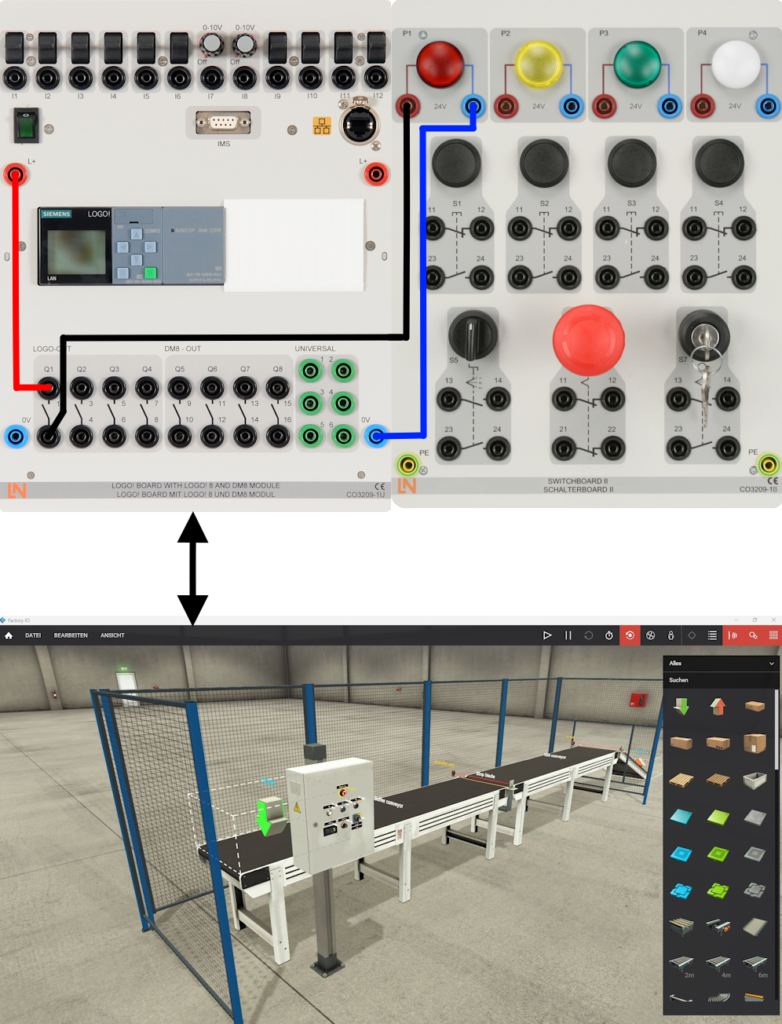
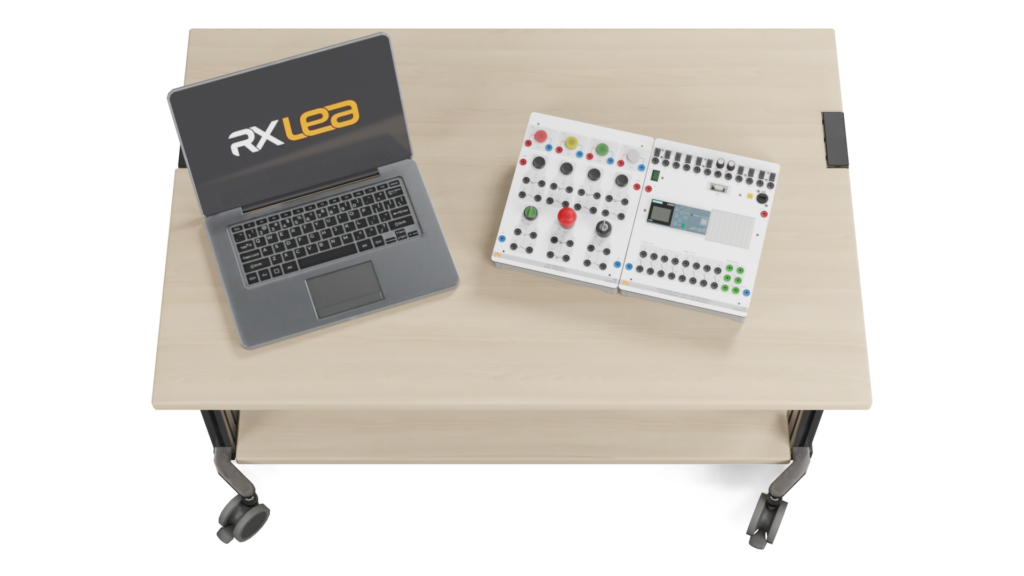
The real strength of modern learning concepts lies in combining both worlds. When a real Siemens LOGO! is connected to a Virtual Industrial System, the two come together. The program runs on a real controller, while its effects become immediately visible in the virtual system model. At the same time, virtual sensors send their signals back to the controller. This creates a closed control loop similar to those found in industrial applications.
Physical push buttons and switches add another important dimension. Learners do not operate the system exclusively with a mouse, but work with the same types of control elements they will encounter later in professional practice.
Learning how modern industry works
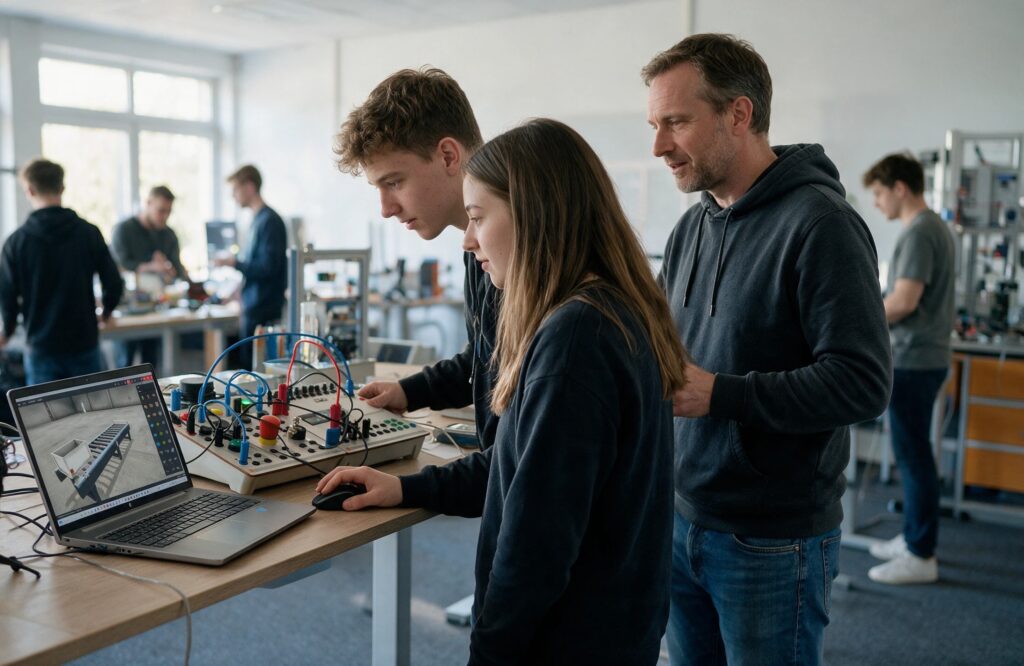
Industrial systems are becoming increasingly complex. At the same time, skilled professionals need to make decisions, isolate faults and understand processes. Operating control software alone is not enough. What matters is understanding how all the components interact. Learning environments that combine real control technology with virtual processes provide strong conditions for developing this understanding. They offer enough freedom to experiment while maintaining a clear connection to real industrial practice.
Real Experience Learning follows exactly this principle. Real hardware forms the starting point for learning and is complemented by digital tools wherever they add meaningful value to the learning process.
Bringing both worlds together
The future of technical education lies in combining virtual and real learning environments. Virtual systems provide access to a wide variety of applications and create space for experimentation. Real controllers and operating elements ensure that learners actively interact with technical systems and understand how their decisions affect system behaviour. This combination prepares learners for a working world in which digital models and real industrial systems have long since become naturally interconnected.
Would you like to learn how Virtual Industrial Systems can be combined with real control technology to create a hands-on learning environment?
About Lucas-Nülle GmbH
Lucas-Nuelle develops smart training solutions that combine theoretical knowledge with real-world practice, enabling learners to experience and understand complex concepts through hands-on engagement. Using tangible, industry-relevant systems, our approach ensures that learning is not only effective but memorable — because when people do things themselves and connect emotionally with the process, knowledge sticks. Our training systems integrate a user-friendly e-learning environment with real equipment and structured courses across key technologies such as mobility, building, energy and industry.
Article Submitted by
Dagmar Bona
Lucas-Nülle GmbH