Automation now shapes almost every area of industry. Production lines operate around the clock, processes are monitored digitally, and machines make decisions within fractions of a second. When discussing these developments, topics such as robotics, artificial intelligence, and Industry 4.0 often take centre stage. Yet one technology frequently remains in the background, despite being indispensable to modern industrial processes: control engineering.
Control engineering ensures that processes remain stable, resources are used efficiently, and products consistently meet high quality standards. As industry and infrastructure become increasingly automated, understanding the mechanisms behind these processes becomes ever more important.

What Truly Makes Modern Automation Possible
Automated systems rarely operate under constant conditions. Temperatures change, loads fluctuate, material properties vary, and external influences affect processes. To ensure reliable operation, systems must continuously respond to these changes.
This is where control engineering comes into play. It continuously compares the desired setpoint with the actual value and adjusts system behaviour accordingly. This principle can be found in countless industrial applications. Conveyor systems must maintain a constant speed, production machines must position components with precision, and process engineering plants must regulate parameters such as filling levels or temperature within defined limits. What may appear straightforward at first glance is based on sophisticated closed-loop control systems. Without them, many automated processes would be neither precise nor economically viable.
From Stable Processes to Sustainable Production
The importance of control engineering extends far beyond process stability. Rising energy costs, limited resources, and growing sustainability requirements have placed increasing emphasis on the efficiency of industrial processes. Optimized control loops help reduce energy consumption, minimize material usage, and prevent waste. At the same time, they improve system stability and reduce unplanned downtime.
As a result, control engineering makes a significant contribution to both the competitiveness of industrial companies and the sustainable development of manufacturing processes. Professionals who understand and can optimize these systems are therefore becoming increasingly sought after around the world.
The Skills Gap: Why Control Engineering Is Often Underestimated
Despite its central importance, control engineering is often perceived in education as a discipline whose relevance only becomes apparent later. Many learners experience automated systems primarily through their results. A machine produces a component, a motor maintains its speed, or a process reaches the required temperature. The control processes behind these outcomes often remain abstract.
As automation continues to advance, however, the role of technical professionals is changing. Their work increasingly involves analysing processes, identifying the causes of deviations, and optimizing the behaviour of complex systems rather than simply operating individual machines. This requires a solid understanding of control loops, system dynamics, and interactions. Anyone who wants to understand automation must understand how systems respond to changing conditions and why they behave the way they do.
Learning Control Engineering Means Understanding Systems
This is precisely why control engineering offers such significant value in technical education. It does more than teach technical knowledge; it develops systems thinking. Learners begin to recognize relationships between cause and effect. They observe how parameters influence system behaviour, analyse responses to disturbances, and develop an understanding of complex interactions.
This learning process goes far beyond memorizing formulas. Genuine understanding develops through observing, analysing, and optimizing real or didactically prepared systems. Such experiences foster practical competence—a capability that is becoming increasingly important in modern industrial environments.

Learning Environments Must Make Control Visible
To make control engineering understandable, learning environments must make the often invisible processes behind automated systems visible. Particularly effective are learning concepts that allow learners to experience different control systems firsthand, adjust parameters themselves, observe the effects, and analyse system behaviour. Variables such as speed, position, filling level, temperature, or light intensity provide practical examples that can easily be transferred to industrial applications.
Digital tools further support this learning process. Time-response diagrams, step responses, and frequency analyses help visualize control processes and make system behaviour easier to understand. Combined with real or didactically emulated systems, they create learning environments where theory and practice are directly connected.
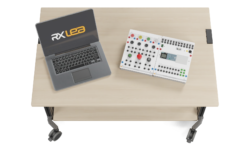
Approaches such as Real Experience Learning follow exactly this principle. Rather than working exclusively with theoretical models, learners experience firsthand how control engineering influences technical systems and how their own decisions affect process behaviour. This creates an understanding that extends beyond technical knowledge and forms a solid foundation for future work in industrial applications.

Conclusion: AI Competence Starts with Understanding
Automation is often associated with visible technologies such as robots, sensors, or artificial intelligence. However, the foundation that enables many of these technologies often remains unseen.
Control engineering ensures that industrial processes operate reliably, efficiently, and with stability. It forms the backbone of modern automation and has become a key competency for the next generation of technical professionals.
Educational institutions face the challenge of fostering this understanding from an early stage. After all, the future of industry depends not only on new technologies, but also on people who can understand, analyse, and optimize complex processes.
Discover how modern training systems help learners develop a practical understanding of the fundamentals and applications of control engineering while strengthening systems thinking.
About Lucas-Nülle GmbH
Lucas-Nuelle develops smart training solutions that combine theoretical knowledge with real-world practice, enabling learners to experience and understand complex concepts through hands-on engagement. Using tangible, industry-relevant systems, our approach ensures that learning is not only effective but memorable — because when people do things themselves and connect emotionally with the process, knowledge sticks. Our training systems integrate a user-friendly e-learning environment with real equipment and structured courses across key technologies such as mobility, building, energy and industry.
Article Submitted by
Dagmar Bona
Lucas-Nülle GmbH